
Eyes are Deteriorating, when Will My Vision Stabilize?
August 2023
We often get the question whether treatment is possible when your prescription still seems to be changing. And does the prescription still change after treatment? In this article, we discuss the structure of the eye, which prescription changes occur, and how the actual prescription of the eye can be measured.
Structure of the Eye
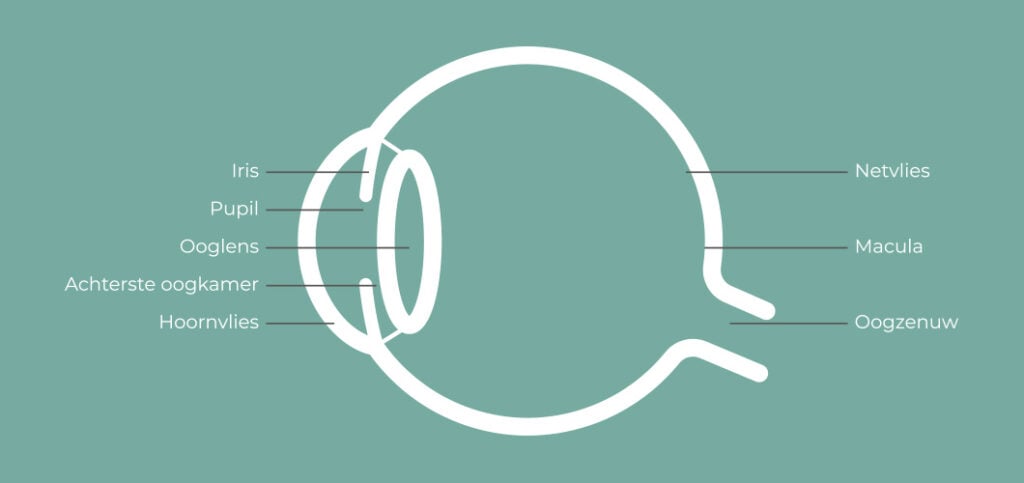
The human eye is a complex and sensitive organ. The components that contribute to the eye’s prescription are the curvature of the cornea, your natural eye lens, and the length of the eye.
The eye works like a camera. Light enters the eye and is refracted by the cornea. The light then passes through the eye lens, which can focus by refracting the light more or less. The light continues through the eye and eventually falls on the retina. From the retina, all light signals are transmitted to the brain.
To see sharply, the light must fall as a point on the retina. For this to happen, the light rays must be refracted sufficiently, but not too much, by the cornea and eye lens, and the length of the eye must align perfectly with this.
The three components – the curvature of the cornea, the eye lens, and the length of your eye – must therefore be in balance. Otherwise, this affects your vision. Each component is therefore important.
An eye where the curvature of the cornea, the natural eye lens, and the length of the eye are perfect refracts light evenly and focuses it precisely on the retina. This results in a sharp image.
When these are not in balance, this results in a blurry or distorted image.
Parts of the Eye – Do these Change?
The cornea still changes during the first months of life. After that, hardly at all, unless you have a corneal condition. At FYEO, we rule this out during a preliminary examination, where we thoroughly map the cornea in various ways.
The length of the eye still changes during childhood and puberty. As long as the body is still growing, you can see that the length of the eye can also still increase. Generally, you see that after your 18th year, the length no longer changes. Some exceptions to this are extremely long eyes, where length growth can continue until the early 20s. During the preliminary examination, we measure the current prescription and length of the eye. If there is doubt during the preliminary examination whether eye length growth has already stopped in your case, the preliminary examination will be repeated after a few months.
The natural eye lens is very flexible in young years and can curve and relax very well: accommodate. Gradually, this eye lens becomes stiffer and stiffer, so the lens can curve less and less and it takes longer before it becomes curved and can relax again. You can notice this because near vision eventually becomes more difficult. Additionally, small opacities can develop in the eye lens. The location of these opacities causes the prescription to change slightly in some people.
Why Does an Eye Measurement at the Optician Always Give a Different Value?
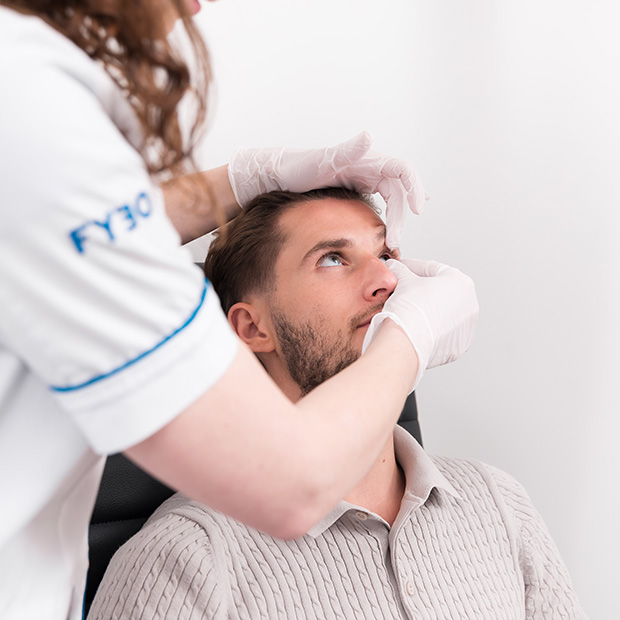
There are various factors that can lead to variations in the optician’s measurements:
Fluctuations throughout the day: The quality of the tear film, the thin layer of moisture on the eye, can fluctuate during the day, which can lead to small changes in visual acuity;
Lens accommodation: If you have looked at close objects a lot, the lens can temporarily “get stuck” in a more curved form, which can influence the measurement. This causes you to measure more minus prescription than your eye actually needs;
Always the Best Result
At FYEO, we always aim for the best result. For this, all components and health of the eye are thoroughly and comprehensively mapped in multiple ways during the preliminary examination.
When you qualify for an ExtraLens or laser eye treatment, it is necessary to perform a very accurate eye measurement to achieve the best result. In addition to a normal eye measurement, like those performed at the optician, we also perform an eye measurement after you have had special drops in your eye. These drops, called cyclo drops, ensure that the natural eye lens temporarily cannot focus. This allows us to measure the actual prescription the eye needs.
For a ReplaceLens treatment, this is not necessary because the natural eye lens, which is responsible for the still-changing prescription in the eye as we get older, is completely replaced by an artificial lens. Instead, during the preliminary examination for a ReplaceLens treatment, the focus is mainly on the curvature of the cornea, the length of the eye, and the location where the new lens will be placed. With these variables, we can measure the prescription of the new lens. Once replaced, there are no more parts of the eye that can change the prescription.
Conclusion
During childhood, the eye’s prescription can change. Once puberty is over, it stabilizes. Small changes in prescription are often caused by the method of eye measurement, the condition of the tear film, and the timing of measurement. Using advanced measurement techniques and cyclo drops, among others, we at FYEO can always accurately measure the actual prescription of the eye. This way, you can be sure you get the best solution for your eyes.